
Finding the Right Words
Or: What you know, and what you do with it

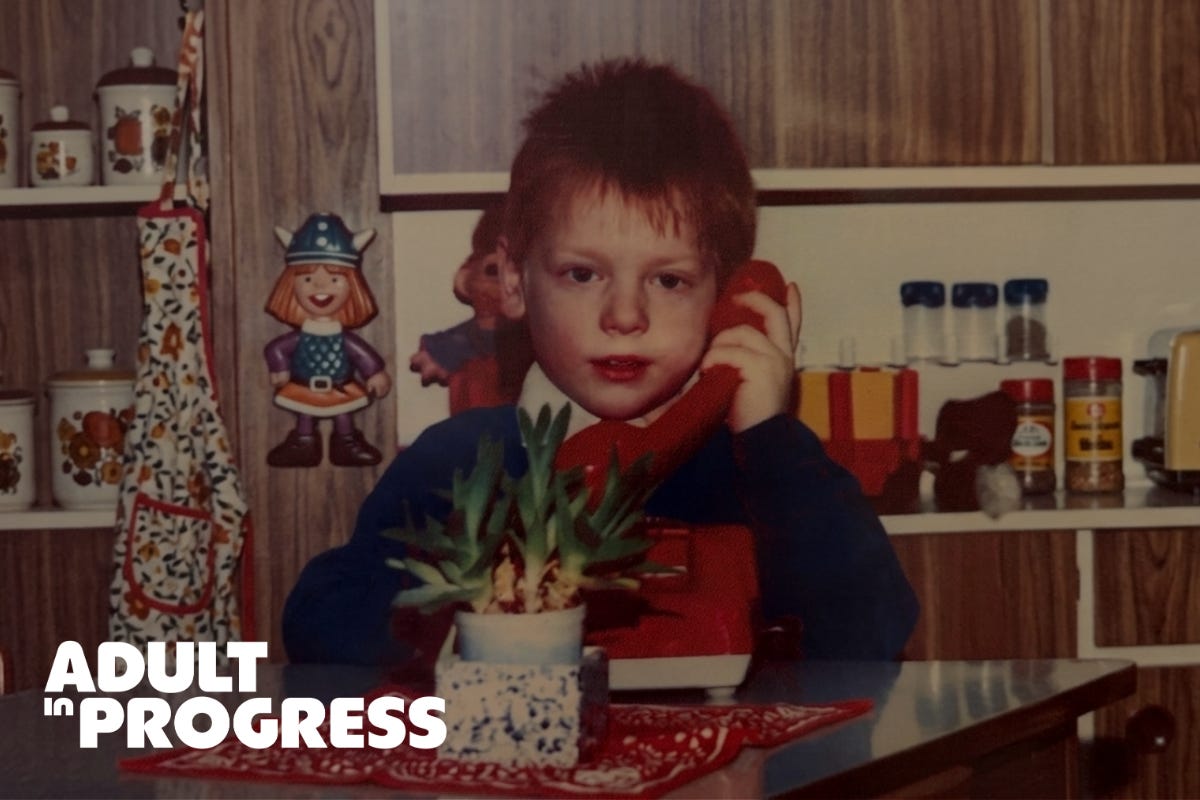
My parents never talked about depression or trauma. Not because it didn’t exist, but because their language simply didn’t have words for it. You carried on. You functioned. You put the heavy things in a room, slammed the door, and buried the key somewhere in the front garden.
I, on the other hand, now have a term for almost everything from my childhood. For the dynamics that felt normal then and have technical names now. For the patterns that only revealed themselves years later. For what happens between people when nobody talks and for what keeps happening behind the façade anyway. One shared Christmas is enough to name every dysfunction in the room.
Is that better? I honestly don’t know. But one of us ends up paying the bill.
We Have Too Much Language and Still No Clue
We’re the first generation to analyse our childhood in reverse, collectively, with tools our parents never had: attachment styles, core‑wound inventories, nervous‑system regulation courses, “cycle breaker” communities. An entire ecosystem grew because one generation decided silence wasn’t a solution and that you need language for what happened to you.
Silence damaged generations. My parents’ silence left marks. Not because it was malicious, but because unnamed things don’t disappear. They go underground. And sooner or later they come back up, in a different shape.
We got language. A lot of language. Precise, nuanced, psychologically informed language. The terms earlier generations lacked are now everywhere: in books, in podcasts, in therapy, in conversations with friends who use the same tools.
But the problem with too much language is simple: you can hide behind it. Naming can feel like doing. Understanding can feel like changing. And the well‑phrased Instagram post about your childhood dynamic can create the illusion of progress when really you’re just describing, very precisely, what you’re not doing.
Fleeing into language is also a form of avoidance. Just one that sounds well‑read.
Naming Isn’t Understanding
Right now, we’re living through the first step intensely: naming. Gaslighting, parentification, emotional neglect, anxious‑avoidant attachment. These terms are woven into everyday speech, and that’s good. It’s good that we can name what happened to us. It’s good that language exists where silence used to be.
But naming can create the illusion that something has already been done. That diagnosis equals change. That recognising a pattern automatically breaks it.
It doesn’t.
And that’s where a frustration sits that my parents never had: I see my patterns coming. I can name them while they happen. I know where they come from, what sets them off, why I react the way I do. And then I react that way anyway. The behaviour is faster than the knowledge.
That’s the particular helplessness of our time. My parents did things without knowing why. I do them and know exactly why. But the knowing doesn’t make them smaller. It just makes them better documented.
Between naming and actual change lies a lot of work that can’t be described in advance, let alone planned. It happens in unremarkable moments. When you’re tired. When stress is high.
My parents often didn’t know why they did what they did. They just did it. That’s an explanation, not an excuse.
Between Two Languages
I try to make sense of my parents’ stories to make sense of my own through them. I try to understand what shaped them, which dynamics they reproduced, what they passed on without knowing.
I try to recognise the patterns. And every time, I see how they keep running in me. And then I sit there in the middle of it, not knowing which language is the right one. The old one of my parents that stayed quiet and carried on feels wrong. Too narrow, too willing to normalise things that shouldn’t be normalised.
The new one, with all its terms, concepts, therapeutic vocabulary, sometimes feels too big for what is actually just an ordinary Tuesday. Not every difficult conversation is a trauma. Not every reaction I dislike is a trigger. Not every bit of tension needs a clinical term before you can talk about it.
Finding the right language somewhere between “don’t be so dramatic” and “that’s a trauma response”, that’s one of the real tasks of growing up now. One nobody explains to you. One you don’t learn so much as practise. Daily, imperfectly, with mixed results.
The Language That Overwhelms Everyone Else
There’s another problem with this new language: it often overwhelms the very people you want to speak it with.
I use a term, like boundary, need, capacity, trigger, and watch the other person get irritated or take an inward step back. Not out of ill will. But because these words, however precise they are for me, sound to others like they come from a vocabulary they never learned, or one that stirs up their own unresolved things. I say “I don’t have the capacity for this right now” and mean it sincerely, and I immediately hear how it lands: distant, clinical, a bit like an out‑of‑office reply.
Especially with people who never needed this language, it can feel like I’m turning a conversation into a therapy session they didn’t book. My parents respond to emotional depth roughly the way I respond to a tax return: with polite bafflement, mild reluctance, and the hope that it’ll be over soon.
And sometimes they’re right. Sometimes this precise language brings people closer, and sometimes it’s a very elegant way of keeping your distance. A technical term can be a bridge. It can also be a wall you’ve wallpapered with better vocabulary.
The real skill is finding the right language not just for yourself, but for the person across from you. And that’s harder, because it requires two translations and then some shared ground between them.
What Balance Doesn’t Mean
Balance between past and present doesn’t mean leaving the past behind. That’s the promise of the self‑help industry: transformation, closure, “healing your inner child” as a project with a completion date. The suggestion is that you’re done at some point with the processing, the understanding, the carrying.
That idea is wrong. Or at least: it isn’t true for most people. The past doesn’t disappear. It becomes manageable, when things go well. It moves into the background. But it stays.
Balance also doesn’t mean staying in the past and reading everything through its lens.
That’s the other trap: when every reaction today is an echo of yesterday, and the person across from you is never just themselves, but always also mother, father, or the child you once were. When the present has no reality of its own because it’s constantly traced back to where it came from.
Balance is unspectacular: you carry both at once. Experience and knowledge. Past and present. Old pattern and new decision. You know where something comes from — and still decide what to do with it now. Not once, but repeatedly. Not conclusively, but continuously.
It sounds exhausting. And often it is. But if long, functioning relationships matter to me, that’s the price.
What My Parents Had That I Don’t
Here’s an irony I didn’t see for a long time: my parents had no language, but because of that they also had a certain lightness about what they didn’t know. They didn’t analyse. They didn’t ask why they reacted the way they did. That produced damage. But it also spared them something: the burden of permanent self‑observation.
I observe myself. I analyse myself. I ask whether my reaction is authentic or conditioned, whether I’m acting out of fear or conviction, whether what I feel belongs to me or comes from an old story. That’s probably useful in the long run. In the moment, it’s often just tiring. And sometimes I wish I could switch my head off.
Knowledge has a price. The price is that you don’t get the not‑knowing back. You see the patterns and then you have to decide what to do with what you see.
My parents had no language. I have too many. Both leave marks. The difference is that mine are well documented.
Maybe growing up, in my generation, is exactly that: not arriving, but finding a language. For what was. For what is. For the difference between the two and for what doesn’t fit neatly into either. My parents never did this. I do it, with everything that comes with it. With therapy, with time, with conversations that come too late or exactly on time. And with the suspicion that the right language is never finished. It’s always still becoming.
That’s uncomfortable. And still, for me, that’s exactly right.